
Catalina Espinosa
Research expert covering society, economy, and politics for Europe and the EU
Over the last 200 years, the world's population has grown rapidly. Whereas only around one billion people lived on the Earth in the early 19th century, the total population has reached over eight billion in 2023. This number is expected to continue to increase over the coming decades, arriving at almost 10 billion by 2060, before flattening more in the latter half of the 21st century. This development sets up huge challenges for future generations. For instance, in 2025, humanity is currently using nature's resources 1.8 times faster than ecosystems can regenerate. This means that 1.8 Earths would be needed per year if this pace of consumption continues, as people are emitting more carbon dioxide than the biosphere can absorb, using more freshwater than can be replenished, and overusing finite natural resources.
While it is anticipated that some continents will experience population decreases in the coming years, the forecast global population growth by continent shows that Africa is expected to witness a population increase from 1.5 billion people in 2025 to over 3.8 billion in 2100. Moreover, the population share of young people is greatest in Africa compared to the rest of the world. Indeed, in 2024, more than 40 percent of Sub-Saharan Africa’s inhabitants are less than 15 years old. Of course, the rate and amount of the population increase depend on future events such as famines and epidemics. Finally, African countries are some of those that will be hardest hit by climate change, which will also have an impact on internal migration, as well as population developments.
While African countries tend to have populations with a higher proportion of young people, opposite is true in developed countries. For instance, most of the countries with the highest median age in the world are found in Europe and some Asian countries such as Japan. In these regions people also tend to live longer, with Japan also being one of two countries with the highest life expectancy. However, Asia and Europe host many of the countries with the lowest fertility rates, meaning that the population increase can only be sustained by immigration.
As a result, Europe’s population is estimated to decrease by more than 150 million by 2100. Already, many of these countries are facing a decrease in the working-age population and an increase in the older age population, forcing governments, companies, and families to rethink employment and elderly care over the coming decades. In other words, whereas some of the challenges related to an increasing population, such as tackling climate change, are global, different regions and countries will have their own demographic challenges to resolve too.

Detailed statistics
World population - forecast about the development 2024-2100

Detailed statistics
Countries with the largest population 2025

Detailed statistics
Global megacity populations 2025

Total population worldwide 1950-2100
World: total population from 1950 to 2023, with projections until 2100 (in thousand inhabitants)

Distribution of the global population by continent 2024
Distribution of the global population 2024, by continent

Global population 2000-2024, by gender
Global population from 2000 to 2024, by gender (in billions)

Global age distribution by region 2024
Global age distribution by region in 2024
Countries with the largest population 2025
Twenty countries with the largest population in 2025 (in millions)
Global megacity populations 2025
Largest urban agglomerations worldwide in 2025, by population (in 1,000s)

Countries with the smallest population 2025
Twenty countries with the smallest population in 2025

Countries with the highest population growth rate 2025
The 20 countries with the highest population growth rate in 2025 (compared to the previous year)

Countries with the highest population decline rate 2025
The 20 countries with the highest population decline rate in 2025 (compared to the previous year)

Population in Africa 2025, by selected country
African countries with the largest population as of 2025

Total population APAC 2024, by country
Total population in the Asia-Pacific region in 2024, by country or territory (in millions)

Population of Europe in 2024 by country
Estimated population of selected European countries in 2024

Total population in LAC 2023, by territory
Total population in Latin America and the Caribbean in 2023, by territory (in 1,000s)

Population in the states of the U.S. 2024
Resident population of the U.S. in 2024, by state (including the District of Columbia) (in millions)
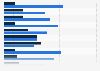
World population by age and region 2024
Proportion of selected age groups of the world population in 2024, by region

Number of centenarians worldwide 2000-2100
Number of people aged 100 and older (centenarians) worldwide from 2000 to 2100 (in 1,000s)

Number of centenarians worldwide by gender 2000-2100
Number of people aged 100 and older (centenarians) worldwide from 2000 to 2100, by gender (in 1,000s)

Largest female population share 2024, by country
Countries and territories with the highest share of women worldwide as of 2024

Smallest female population share 2024, by country
Countries and territories with the lowest share of women worldwide as of 2024

Global population density by region 2025
Population density worldwide in 2025 by region (in inhabitants per square km)

Highest population density by country 2024
Countries with the highest population density worldwide in 2024 (in inhabitants per square km)

Cities with the highest population density globally 2025
Cities with the highest population density worldwide in 2025 (in inhabitants per square km)
World population - forecast about the development 2024-2100
Forecast about the development of the world population from 2024 to 2100 (in billions)

Forecast: world population, by continent 2100
Forecast of the world population in 2025 and 2100, by continent (in billions)

Global population distribution 1800-2100, by continent
Annual share of the global population living in each continent from 1800 to 2021, with projections until 2100

Projected world population distribution, by age group 2024-2100
Projected distribution of the world's population from 2024 to 2100, by age group
Feel free to contact us anytime. We will respond to your inquiry as quickly as possible.


