
Einar H. Dyvik
Research expert covering Nordics and global data for society, economy, and politics
Taxes imposed on imported or exported goods, otherwise called tariffs, have been central to U.S. trade policy since the Constitution came into effect in 1789. While originally intended to protect domestic industries and generate revenue, today they are often employed as economic and political tools to influence trade relationships. In recent years, U.S. tariffs have held particular significance in trade disputes, primarily with China. Under the first Trump administration, the U.S. imposed tariffs on billions of dollars' worth of Chinese goods, prompting retaliatory tariffs on American products. By the end of 2024, American importers had paid over 260 billion U.S. dollars in trade war duties.
In the early months of his second presidency, President Trump unveiled an aggressive trade agenda centered on sweeping tariffs aimed at reshaping U.S. trade relationships. His proposals included a universal 10 percent baseline tariff on all imports, projected to generate an estimated 2.95 trillion U.S. dollars in revenue. However, in early April, President Trump made an executive order to implement new, widespread tariffs across more than 100 countries in what he called “Liberation Day”. In addition to the baseline tariffs, Trump also announced specific tariffs on a number of important trading partners, such as the European Union, China, and Vietnam, which account for over 40 percent of all U.S. imports. Shortly after, Trump announced a 90-day suspension of the newly introduced tariffs. However, the heightened tariffs on Chinese goods remained in place, resulting in China imposing counter-tariffs on a range of American exports, including coal, liquefied natural gas, machinery, and large motor vehicles.
In anticipation of the tariffs that took effect on April 5, the Dow Jones Industrial Average plunged by 1,679 points, or a decline of 4 percent, while the S&P 500 dropped 4.8 percent, marking its worst single-day performance since 2020. The sell-off erased over three trillion U.S. dollars in market value within days, eclipsing several historic economic crises. While U.S. markets sustained the heaviest effects, Trump’s escalating trade war lurched global financial markets into the steepest downturn since the COVID-19 pandemic, with global market capitalization losing ten trillion U.S. dollars, translating into over half of the entire GDP of the EU.
In January 2026, as President Trump put pressure on Greenland, Denmark, and European countries to gain control of the island, he threatened to impose a 10 percent tariff on imports from seven European countries backing Denmark's stance that Greenland is not for sale. Trump later backed down on the threats, but they again highlighted the volatile nature of the U.S. President's trade policy. As a result of a decreasing trust in the U.S. as a stable trading partner, but also because of increasing investment opportunities abroad and a sell-off in the bond market in Japan, the U.S. dollar has been losing value, for instance against the euro.
Trade between the U.S., Mexico, and Canada is deeply connected, with the United States-Mexico-Canada Agreement (USMCA) facilitating high volumes of trade across North America. The U.S. and Mexico’s trade relationship has done nothing more than increase in the past two decades. In fact, the total trade value of goods between the two countries has almost tripled from 2004 to 2023, reaching almost 800 billion dollars. Interestingly, while Mexico led in overall import value, Canada demonstrated its importance as the primary import partner for 23 U.S. states in 2024. The total value of U.S. trade in goods with Canada reached an impressive 774 billion U.S. dollars in 2022, 421.1 billion of which were imports. A trade deal originally designed to facilitate free trade among North American countries, Trump’s proposed tariffs would directly conflict with the USMCA. A broad tariff would override certain conditions and potentially violate the agreement, as well give rise to retaliatory tariffs from Mexico and Canada. The U.S. automobile industry, for example, relies heavily on supply chains across all three countries and would be particularly impacted if tariffs were imposed. The ripple effect tariffs create extends beyond North America, impacting trade relations transnationally and shaping economic policy for years to come.

Detailed statistics
Main import partners of states in the U.S. 2024, by share of total imports

Detailed statistics
Top five imported products 2023 in the U.S., by type of product and country of origin

Detailed statistics
U.S. approval for imposing 25 percent tariff on Mexican and Canadian goods 2025

Average actual tariff rate on all imports to the U.S. 1821-2025
Average effective tariff rate on all imports in the United States from 1821 to 2025, with estimated rate for 2025 under Trump's imposed tariff

Historical average tariff rate on imports and dutiable imports in the U.S. 1821-2025
Average tariff rate on all imports and dutiable imports in the United States from 1821 to 2024 and estimated rate for 2025 under Trump's initial proposal

Main import partners of states in the U.S. 2024, by share of total imports
Main import partners of states in the United States in 2024, by share of total state imports

U.S. imports - top trading partners 2024
Ranking of the top trading partners of the United States for trade goods in 2024, by import value (in billion U.S. dollars)

International trade as a share of GDP among USMCA members 1970-2024
Trade in goods and services as a share of gross domestic product (GDP) in the United States, Canada, and Mexico from 1970 to 2024

Export and import value of U.S. trade in goods with Mexico 2004-2024
Total value of U.S. trade in goods (export and import) with Mexico from 2004 to 2024 (in billion U.S. dollars)

Total value of U.S. trade in goods with Canada 2004-2024
Total value of U.S. trade in goods (export and import) with Canada from 2004 to 2024 (in billion U.S. dollars)

Total value of U.S. trade in goods with China 2014-2024
Total value of U.S. trade in goods (export and import) with China from 2014 to 2024 (in billion U.S. dollars)

Customs duties and tariff revenue in the U.S. 2000-2035
Annual customs duties and tariff revenue of the United States government from 2000 to 2024 with a forecast to 2035 (in billion U.S. dollars)
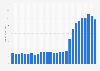
Monthly customs duties and tariff receipts in the U.S. 2023-2025
Monthly customs duties and tariff revenue of the United States government from November 2023 to October 2025 (in billion U.S. dollars)

Revenue change as a share of GDP across major tax laws in the U.S. 1940-2026
Average annual revenue change as a share of GDP across major tax laws and Trump's tariff policy in the United States from 1940 to 2026

Estimated economic impact of Trump's proposed tariffs in the U.S. 2025
Estimated impact of President Trump's proposed tariffs on GDP and capital stock in the United States as of November 2025

Impact of Trump's proposed tariff on household expenses in the U.S. 2024
Impact of Trump's proposed tariff on household expenses in the United States as of March 2024

Projected revenue from universal tariffs in the U.S. 2025-2034, by tariffs level
Value of conventional revenue from universal baseline tariffs on imported goods in the United States from 2025 to 2034 (in trillion U.S. dollars), by tariff level

Impact of trade war tariffs on households 2018-2023, by average collection
Impact of trade war tariff collections on households in the United States from 2018 to 2023, by average collection per household

Trade war tariff collection under Biden and Trump administrations, by section 2024
Cumilative trade war tariff collections under the Biden and first Trump administration in the United States as of 2024, by trade section (in billion U.S. dollars)

U.S. items Americans are planning to purchase ahead of Trump's tariffs 2025, by age
Which items Americans are planning to purchase in advance of Trump's proposed tariffs in the United States in 2025, by age

Impact of import tariffs on wind energy costs in the U.S. 2025
Key figures on the forecast impact of import tariffs on onshore wind energy costs in the United States as of February 2025
Top five imported products 2023 in the U.S., by type of product and country of origin
Top five imported products in the United States in 2023, by type of product and country of origin

Value of U.S. agricultural imports from Mexico 1990-2025
Value of U.S. agricultural imports from Mexico from 1990 to 2025 (in billion U.S. dollars)

Value of U.S. agricultural imports from Canada 1990-2024
Value of U.S. agricultural imports from Canada from 1990 to 2024 (in billion U.S. dollars)

U.S. automotive part imports by leading country 2023-2024
U.S. automotive part imports in 2023 and 2024, by leading country (in U.S. dollars)

Automotive part imports and exports of the U.S. with Mexico 2008-2024
United States' import and export value from its automotive part trade with Mexico between 2008 and 2024 (in U.S. dollars)

Global oil imports 2024, by country/region
Leading crude oil and oil products importers worldwide in 2024, by region or major country (in 1,000 barrels per day)

U.S. electricity imports from Canada 2000-2024
Electricity imports to the United States from Canada in selected years from 2000 to 2024 (in terawatt-hours)

Imports for consumption of steel products to U.S. by origin 2025
Imports for consumption of steel products into the U.S. in 2025, by origin (in million U.S. dollars)

Decrease in the share price of selected automotive companies February 2025
Decrease in the share price of selected automotive companies on the morning of February 3rd, 2025, after Donald Trump's tariff announcement

Public approval of President Trump's trade and tariff policy 2025
Public approval rating of President Trump's handling of international trade and tariffs in the United States from May to November 2025

Public confidence in knowing what a tariff is in the U.S. 2024
How confident adults are in knowing what a tariff is in the United States in 2024

Public support for higher or lower tariffs in the U.S. 2026, by party
Share of Americans who believe tariffs on foreign goods should increase or decrease in the United States in January 2026, by party
U.S. approval for imposing 25 percent tariff on Mexican and Canadian goods 2025
Approval for imposing a 25 percent tariff on goods imported from Mexico and Canada in the United States in 2025

U.S. justifiable circumstances for the government imposing tariffs 2024
What circumstances Americans think the government should impose tariffs in the United States in 2024

Public opinion on the impact of higher tariffs on prices in the U.S. 2024-2026
What effect Americans think increasing tariffs has the price of foreign goods in the United States in Februray 2024 and January 2026

U.S. ways in which imposing higher tariffs would help or hurt certain factors 2024
Perceived ways in which imposing higher tariffs would help or hurt certain factors in the United States in 2024
Feel free to contact us anytime. We will respond to your inquiry as quickly as possible.


